


1823
The area around Florissant is fertile an offers a lot of resources for St. Louis. The soil is excellent and there is wood and water in abundance. But for the European boys life on the frontier is hard and primitive. Without harvest the Jesuits have no income. Mother Duchesne and the other Sisters of the Sacred Heart help their neighbours as much as possible. However after a few months two young boys decide to quit. In these primitive circumstances and without books Charles Van Quickenborne and Pierre Verhaegen do all that they can to transfer the essential knowledge to their students.
1824
On May the 31st Pierre Timmermans (35) dies of exhaustion. After a last visit to his young recruits Charles Nerinckx also passes away in Sainte-Geneviève. He is 63. In Florissant Van Quickenborne is now completely on his own. He combines the tasks of superior, professor and confessor for the students, for the Sisters, and for a number of distant parishes. He urgently needs reinforcement! .
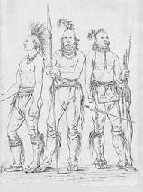
In addition to his numerous tasks Van Quickenborne operates a small school for young Indian boys in Florissant. The St. Francis-Régis seminar mainly attracts children of the Osages Indians. De Smet is allowed to teach them and while doing so he becomes well acquainted with the first inhabitants of the North-American continent. The youngest children learn how to write and speak English. The older ones are taught the basics of agriculture. But to pass their life tilling the soil is not very appealing for these young hunters. Moreover the majority of the Jesuits show little or no interest for the Indian culture. In their opinion these redskins are lazy, unreliable and dirty creatures. De Smet's judgement is less negative and he shows more empathy for the natives and their children. In turn the Sisters open a school for young Indian girls. Their dream is to build a better future for the educated Indians.
1825
Finally reinforcement arrives when Theodore de Theux de Meylandt (36), a recruit of Neirinckx in 1816, is sent to Florissant. For 8 years he held classes at the university of Georgetown, Maryland. When he arrives in October the quality of the instruction clearly improves.
1826
Jean-baptiste Smedts and Pierre Verhaegen are the first to be ordained. In his spare time De Smet collects all sorts of species of plants and animals to send to his correspondents in Europe.
1827
On February the 15th, in the distant Kingdom of the Netherlands, Joost de Smet passes away. It takes a long time for the bad news to reach Florissant, and in the meantime Pieter Jan continues to send letters to his old father.
The Jesuits made plans to alienate the converted Indian pupils from the traditional tribal life and to encourage them to copy white ways and white family life. They hoped that in doing so a permanent native Christian community would become possible in Missouri. The plan has the blessing of John-Philip Roothaan, superior of the Jesuits in Rome, and the approval of president Jackson. But the plan fails because Florissant has insufficient means. In fact there is not enough money to buy land for the new Indian community (sic). The number of pupils decreases every day. Osages are nomads and when they are forced to give up their traditional hunting grounds in Missouri they collect their offspring before relocating to Kansas.
September 23 is an important date: Jean Elet, Josse Van Assche, Felix Verreydt and Pieter Jan De Smet are ordained priests in the St. Stanislaus church in Florissant. From now on Pieter Jan can call himself Father Peter John De Smet, S.J.. He celebrates mass in a number of small communities, some at a distance of 150 miles. Sometimes a barn or a cabin can be transformed into a makeshift church, but very often the mass must be officiated in the open air. The catholic communities are far distant from each other and the journeys are no pick-nick. Navigating on dangerous rivers and spending cold nights under a starry sky, it is all part of their religious mission. On the eve of the Louisiana Purchase St. Louis was a predominantly catholic city, but subsequent immigration waves from the United States brings more and more Protestants to the traditional French city. The arrival of Methodists, Quakers, Anabaptists and Presbyterians means competition for Catholicism, and measures are urgently needed to stem the tide. Youth is the future and for this reason much emphasis will be put on the development of sound catholic education. To promote higher catholic education the superiors of Louisiana, Dubourg and Rosati, offer the Jesuits of St. Louis a patch of land. The Jesuits came to convert the Indians, but they want to help the Catholics of St. Louis and so they agree to start a college in St. Louis. A collection is organized and soon Father Verhaegen is able to initiate the construction of the necessary buildings. Less than one year later, on November the 2nd to be precise, the college can open its gates. On the opening day the boarding school counts a total of 40 pupils. Three months later they are 100. Most of these boys are Protestant and not all of them live in St. Louis. In October Van Quickenborne takes charge of the new college where De Smet teaches religion, English language and agriculture. From now on Catholicism is well established in these parts of the United States. The Protestants are not very happy with this development and the competition between the two beliefs will increase.
1829
The well-to-do community of St. Charles, 10 miles to the north of St. Louis, is an important catholic city. Charles de la Croix ( 38) from St.-Cornelius-Hoorebeke in East-Flanders, Belgium, administers their parish. At the beginning of the century de la Croix was kidnapped in a seminary by the French administration and enlisted in the army of Napoleon. In 1817 de la Croix emigrated to the United States with Dubourg. But now de la Croix urgently requests to be relieved from his heavy duties on the frontier and as a result Van Quickenborne and his assistants inherit his labours in St. Charles, St. Ferdinand, Dardenne, Hancock Prairie and Portage des Sioux
1830
There never were more than 40 boys in the Indian school of Florissant, and when their parents are forced to leave Missouri the school slowly emptied. Finally, with great regret for De Smet, it is closed. The college of St. Louis with its 150 students on the contrary is a growing succes and De Smet is given new responsibilities. He is appointed as procurator, prefect of studies and English professor.
1831
Roothaan decides to split the Jesuit provinces of Maryland and Missouri. From now on Missouri will have to fend for its own. The Superintendent of Indian Affairs, the famous explorer William Clark, as well as Father Van Quickenborne defend the idea that missions must follow the Indians to the west. Van Quickenborne means business, and he leaves de Theux in charge of St. Louis. He moves to Kansas with Van de Velde (one of Neirinckx's recruits in 1817 and the future bishop of Natchez) to establish a new Indian mission.
1832
The state of Missouri grants to the college of St. Louis the status of university with faculties of letters, science, medicine, law and theology. From now on the college, which has been created in 1818 by bishop Dubourg, must offer academic quality education, and the responsibility for the new university weighs heavy on the shoulders of the Missouri province. De Smet teaches English. The year 1832 is also remembered for its disasters. A tornado devastates a large part of the city and the college narrowly escapes from total destruction. And then a cholera epidemic strikes hard, making another 200 victims. The situation is so serious that the college is forced to close for three months. The Province urgently needs more means and more missionaries!
1833
By now 7,500 people live in St. Louis. The sixteen Jesuits can't keep up with the requirements of the Missouri province, nor with the work in St. Louis. Moreover the province has serious financial problems. Many Missouri Jesuits were born in Holland and Belgium and most of them like the idea of joining efforts with the new Belgian Jesuit province. De Smet offers to go to Europe to defend this idea and to seek help. Furthermore, ten years of deprivations on the frontiers have seriously affected the missionary's health. He urgently needs some rest. At the end of the month September, after a speedy naturalization procedure, he leaves St. Louis as an American citizen on his way to Georgetown en route for Europe.