


1841
Verhaegen approves the establishment of a permanent mission in the Rocky Mountains under the direction of Father De Smet. But what about the funding ? No problem. De Smet prints a few thousand pamphlets and organizes a successful collection in Louisiana. His trip to New Orleans alone yields 1100 dollars! Part of the collected money will be set aside for the unfortunate Potawatomi Indians (to be relocated once more), a sum will be offered to the school for Indian girls of Madame Duschene, and with the remainder Peter John is able to start his reduction in the Rockies.
On April 24 De Smet leaves St. Louis for Westport on the Oceana. His travel companions are Father Gregorio Mengarini, Brother Charles Huet, Brother Joseph Specht and Brother Willem Claessens. Mengarini is an Italian. He is a linguist and a musician. Huet (Kortrijk) and Claessens (Berendrecht) are both Belgians. Claessens is a carpenter. Specht is a blacksmith from the Alsace region in Germany. The water level of the Missouri River is low and the Oceana is forced to navigate carefully. It takes the steamer seven days to reach Westport. Upon arrival De Smet and his companions join Father Nicolas Point. They immediately start making arrangements for the long, tiring and perilous voyage. They purchase six carts with the necessary mules and horses. However, this time the Jesuits cannot travel with the caravan of the American Fur Company. The fur trade is declining and the annual rendezvous system has been abandoned. By a stroke of good fortune the missionaries meet an “unemployed” mountain man who agrees to guide their little party to the Green River. His name is Thomas Fitzpatrick (42). Fitzpatrick hires more experienced Franco-Canadian trappers such as John Gray (Ignace Hatchiorauquacha) to accompany the missionaries.
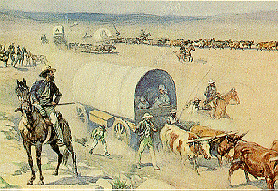
May 10 the missionaries and their guides are ready to start their long westward trek. On horseback they guide five two-wheel carriages, each drawn by a pair of mules, on an unmarked road to the great adventure behind the horizon. But the small caravan is not alone. This year a number of emigrants plan to reach Oregon and California over land. All their vehicles regroup on the banks of the Kaw River at present day Topeka, Kansas. Confronted with this first obstacle they decide to cooperate. A convoy of wagons is organised, leaders are appointed and rules are laid down. The 70 adults and children of the Western Emigration Society, headed by John Bidwell (21), will be the backbone of the group, but for most of them it is their first important overland trip. John Bartleson is chosen as the leader of the emigrants and consequently this caravan will also be called the Bartleson-Bidwell party”. But everybody agrees that the experienced mountain man and guide of the Jesuit party, Thomas Fitzpatrick, should also be chosen as the guide of this important train of 25 carriages. Two days later a small group of five people headed by Joseph B Chiles catches up with the westbound party. May 27 they are joined by Joseph Williams, a protestant preacher apparently travelling on his own to Oregon. The leaders of the caravan require the emigrants to observe an almost military discipline. Orders must be obeyed - to wake-up, to leave, to halt, to take meals, to set-up camp, to sleep and to keep watch. After sunset the campsite is very vulnerable and the unbroken circle of carriages must guarded all night, also by the otherwise peaceful missionaries. During the whole trip there is but one casualty, due to an accidental, but fatal shot. Two couples are married and the Jesuits say mass in their tent. The missionaries increasingly admire the knowledge and know-how of the mountain men who serve as their guides. On this trip Father De Smet and Thomas Fitzpatrick start a lifelong friendship.
The emigrants are among the first travellers on Oregon Trail. Between the Kaw and the Big Blue River (1) an isolated member of the party is suddenly surrounded by a significant number of Indians. These Cheyennes disarm Nicholas Dawson and send him away. Fitzpatrick and Gray stay calm and the Native Americans remain friendly. They even return Dawson’s belongings. Near the South Platte they meet a very large number of bison. The frightened animals stampede and the moving herd threatens to reverse the carriages and to trample the emigrants. Shooting a few bison does the trick. The course of the racing animals is altered and a potentially dangerous situation reversed. The following days bison becomes a fixed item on the menu. The temperature is very high. On one of these torrid days the emigrants are caught up by a violent hurricane and they all but escape from the destructive forces of a waterspout. Near Lower California Crossing (today Brule, Nebraska) they cross the South Platte. Then the caravan follows the southern bank of the North Platte River, along Chimney Rock and Scott' S Bluff. On June 22 they reach Fort Laramie. After a short pause the party resumes their westward course. Near the site of today’s city of Casper (Wyoming) they have to cross the North Platte. The river is so deep that the horses and the mules have to swim. In the swift current a wagon is reversed and as a result a mule drowns. They travel on the banks of the Sweetwater River and visit Independence Rock. Then they reach South Pass and on July 24 they can take a break on the banks of the Green River.
This year the traditional rendezvous area looks very empty and quiet. A few remaining trappers (Henry Fraeb being one of them) and a small group of returning emigrants are the only people to welcome the weary travellers. A young Flathead awaits De Smet and his missionaries. It’s Ignace’s son, François-Xavier. The missionaries continue their voyage with the Bartleson-Bidwell party in the direction of Ham's Fork. At Soda Springs on the Beaver River, the emigrant party decides to split. Bidwell with the principal group will stick to the original plan to travel southwest to California. The others 32 emigrants will carry on with Fitzpatrick and the missionaries. They will eventually continue northwest to Oregon. De Smet and François-Xavier hurry ahead to Fort Hall (Hudson's Bay Company) on the Snake River. When De Smet arrives in the fort on August the 15th, he realises that he left St. Louis 115 days ago. The missionary and his Indian guide are very much welcomed by Francis Ermatinger, the master of the fort. Two days later the rest of the emigrants and the other Jesuits also reach Fort Hall. In the meantime the main body of Smet’s Indian escort arrived. These Flathead warriors are led by a man called the “Bravest-of-the-Brave”. On August 20 bad news reaches the fort. En route to California the Bidwell party has been attacked by hostile Indians! De Smet writes a letter to John Mc Loughlin who lives at Fort Vancouver. He is the boss of the Hudson's Bay Company in the vast territory of Oregon. Ermatinger will guide the remaining emigrant party to Fort Vancouver and deliver De Smet’s letter personally.
The missionaries leave with their escort towards Henry's Fork on the Snake River. En route they suddenly encounter 50 Blackfoot Indians of the Bannocks tribe. Conflict is avoided when the Flatheads explain that the sole purpose of their sortie is to escort the Black Robe to his final destination. Above lake Henry they cross the continental divide to travel west, to the Beaverhead. On August 30, in a sheltered valley, they meet Big Face with the same the group of Flatheads Father De Smet visited last year. In September the whole Indian village moves via Hell Gate (today near Missoula, Montana) to the valley of the Bitterroot. September 29 they erect a cross in an elevated spot near today’s Stevensville, Montana (30 miles north of Missoula). This symbolic gesture marks the creation of the first Jesuit Rocky Mountain Mission: St. Mary’s. De Smet plans to create a series of Indian missions, based on the 17th century reduction model of Paraguay. In the neighbourhood of St. Mary other families set up their winter camp. Among them are Pend d’Oreille, Nez Percé, Kalispel, Kootenai and Coeur d’Alene bands, even some Blackfoot families.
October 28 De Smet leaves with ten Flathead braves towards Fort Colville (Hudson's Bay Company). The fort is approximately 125 miles to the north, on the Columbia River, just above the Kettle Falls. The purpose of this trip is to buy some extra provisions. In order to start the reduction the Jesuits urgently need more food, clothing, sowing-seed, tools, agricultural implements, cattle and other working animals. On his way Father De Smet visits a Kalispel village. The trail skirts the Bitterroot and Clark Fork. On Sunday November 7, while resting in the Kalispel camp, eight Indians in two canoes emerge from the lake. One of them is Charles, the Flathead interpreter he used last year. Charles is now employed by the Hudson's Bay Company. His little party brings a message from doctor Mc Loughlin. The letter dating from the end of September, contains also an invitation to visit the doctor at Fort Vancouver. Charles continues towards St. Mary and Father De Smet resumes his trip to Fort Colville. He stops in another Kalispel village and on November the 15th he reaches the fort. As usual he is made to feel very welcome by the local person in charge: Archibald Mc Donald. Near the fort Father De Smet becomes acquainted with some Franco-Canadians and a chief of the Kettles Indians. He can buy some of the much-needed provisions such as seeds, but there isn’t any cattle for sale. De Smet and his escort retrace their steps using the same road. On December 8, 42 days later, Father De Smet returns safe and sound to his first mission post: St. Mary on the Bitterroot River.
1842
Next spring Father De Smet decides act upon doctor Mc Loughlin’s invitation. April 13 he leaves for Fort Vancouver with Charles and three natives. He will be able to board a Hudson’s Bay Company boat descending the Columbia River. But first he visits the Kootenai Indians on the St. Régis River, the Kalispels on the Pend Oreille River and the Coeur d’Alene on the Spokane River. Near Fort Colville and the Kettle Falls, De Smet and Charles have to wait a whole month. The river is to rough and the water level has to drop considerably before they will be able to navigate. Finally on May 30 they can embark on a boat the Hudson`s Bay Company recently built for Peter Skene Ogden (explorer of the Snake River and the Great Basin). Two days later they reach a series of impressive rapids caused by large rock formations or dalles in the middle of the Columbia River. De Smet feels a bit insecure and asks to disembark. He prefers to climb the obstacles on the shore. Suddenly Ogden’s boat is taken in a swirl. Engulfed by the powerful torrent its rapidly sinks. The boat reappears, but five people are missing. Charles is among the survivors. The survivors of this catastrophe pick up the pieces and De Smet and Ogden continue their voyage. Further downstream they stop at two forts of Hudson Bay Company, Fort Okanagan and Fort Walla-Walla. On June 8 they arrive safe and sound at Fort Vancouver. Father De Smet meets doctor Mc Loughlin and they immediately become friends. He also contacts Father Blanchet and Father Demers. They are both staying in the valley of the Willamette, 24 miles to the south, at St. Paul’s mission to the French Canadian settlers.
June 30 Father De Smet and his guide leave Fort Vancouver. Again they can travel on one of Ogden’s boats. It takes them two weeks of sailing and rowing to reach Fort Walla-Walla. Here Charles shows Father Smet an alternate Indian trail to St. Mary’s. The path parallels the Snake River, crosses the Spokane desert as far as the southern point of the Coeur d’Alene Lake. Then they travel along the banks of the St. Joe River. The St. Mary mission will be reached crossing the next mountain range. On July 27 Father Mengarini welcomes Fathers De Smet and Charles back to St. Mary’s. Mengarini is alone because Father Point joined the Flatheads on their seasonal hunt.
After five days of rest De Smet and Charles leave to join the hunting party. They follow the Bitterroot River until its source (Ross's Hole). After climbing the Gibbon pass, they follow the Big Hole River to the east to reach Three Forks via the Beaverhead. On August 15 they reach the Flahead hunters near the Jefferson and Madison Rivers. Point offers to start a mission among the Blackfoot Indians, but Father De Smet doesn’t like the idea. The Blackfeet have a bad reputation. For the time being this venture seems far too dangerous. Point protests, but Father De Smet maintains his decision. Mengarini will take care of the Flathead and the Pend d’Oreille Indians. This will enable Point and Huet to install a new mission to the Coeur d’Alenes.
Father De Smet decides to return as quickly as possible to the States. On August 25 he leaves with a small escort of ten warriors. Again the cross the Yellowstone desert on horseback. In the meantime Father De Smet has become more knowledgeable on the local situation. He knows how dangerous the area can be for a small group op travellers and he does not want to run any unnecessary risk. In three days they travel 150 miles. On the banks of Yellowstone they are made welcome in a fairly large camp of friendly Crows. De Smet dismisses his escort. He will continue with young Ignace-Gabriel (a Cree) and two Americans he met at the Crow village. They will need six days to reach Fort Union. Their route parallels the Yellowstone River. For some time this area is reputed to be a battleground for the various Assiniboin, Cheyenne, Blackfoot and Sioux tribes. On day they find the terribly mutilated bodies of ten massacred Assiniboins warriors. Struck with terror they hasten their travelling speed and continue the trip until late in the evening, without feeling the need to stop.
However, on September 10 they arrive without any further incident at Fort Union. In the fort they can finally rest a few days in full safety. But the city of St. Louis is still very far away. To save time Father De Smet decides to try his luck at floating down the Missouri. He buys a canoe and Father De Smet and Ignace-Gabriel paddle a few days on the brown water of the powerful river the Americans call the Big Muddy". Three days later they meet the American Fur Company steamer Omega. The crew invites them to board the ship. They will first sail to Fort Union and then return to St. Louis. Father De Smet accepts this godsend offer with enthusiasm, not in the least because the banks of the Missouri are reported to be infested warlike Indians. Sailing the Omega is not without danger. In certain places the water is very shallow. The captain of the ship has to avoid the many sand banks, rocks and other lethal snags, such as the treacherous sawyers (hidden tree trunks). At one time one of the paddle wheels is severely damaged and another time a tornado reverses the cockpit. It could be called a miracle that the seriously damaged Omega manages to reach St. Louis 64 days later, on the last Sunday of October. But Father De Smet is unscathed and as he finished another successful round trip of 5000 miles, he hurries to St. Louis cathedral to thank his lord and taskmaster.
In November the Fathers Point and Huet build their mission to the Coeur d’Alenes on the Spokane River. This first mission is located not far from the northern end of the Coeur d’Alene lake. One year later this Sacred Heart mission we will be moved by Father Point to drier location (one mile up the St. Joe River).
(1) There are several confusing reports of that incident, but that happened between the Kaw and Big Blue River, well before the caravan reached the Platte. Joseph Williams and Dawson really exagerated that story. "..about two weeks after heading out" is what is claimed, and by following the sites mentioned in journals the trail, I'm pretty sure the Indian fracas was near Rock Creek Crossing, at present day Westmoreland, Kansas. (Keith Jones)